In enterprise network design, one of the most common specification questions is: should this run be fiber or copper?
Both have their place. The decision hinges on distance, bandwidth requirements, EMI environment, cost, and whether the run needs to support PoE. Getting it right upfront saves significant retrofit cost later.
This guide provides a practical, engineering-grounded framework for specifying fiber vs. copper Ethernet in commercial and enterprise environments.
The Fundamental Difference
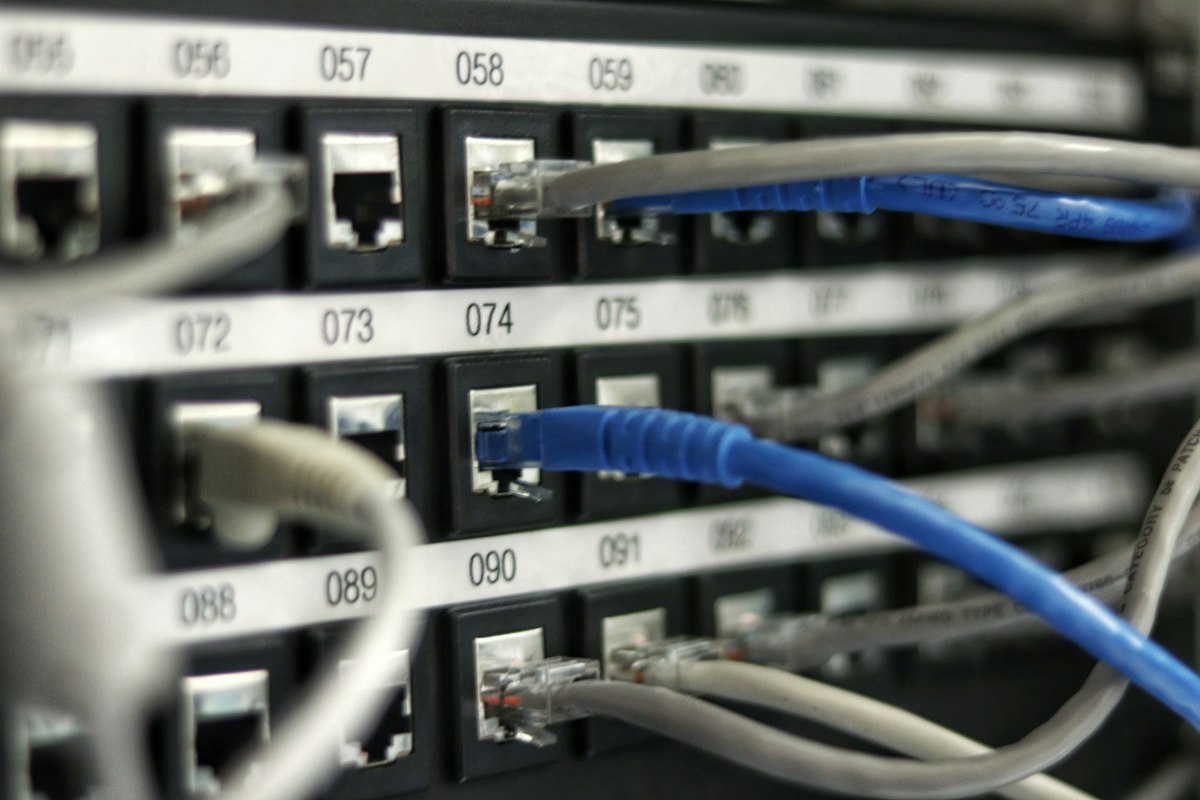
Copper Ethernet (Cat5e/Cat6/Cat6A/Cat8) transmits data as electrical signals over twisted pairs of copper wire. It's the dominant medium for horizontal cabling — the last 100 meters from the IDF to the endpoint.
Fiber optic transmits data as pulses of light over glass or plastic fibers. It's immune to electromagnetic interference, supports far greater distances, and can carry vastly higher bandwidth — but it doesn't support PoE and costs more to terminate.
Copper Ethernet: Where It Excels
The 100-Meter Horizontal Run
Copper's primary domain is horizontal cabling — the runs from IDF/wall jack to endpoint. TIA-568 defines a maximum permanent link of 90 meters (plus 10m of patch cords = 100m channel). Within this constraint, Cat6A delivers 10GbE reliably and supports the full PoE spectrum.
PoE Delivery
Copper is the only option when you need Power over Ethernet. Every IP camera, access point, VoIP phone, access control reader, and smart building device that draws power from the network requires copper. Fiber carries no power.
Cost Efficiency at the Endpoint
Copper is significantly cheaper to terminate, cheaper per port on switches, and uses standard RJ45 connectors that every device supports natively. For high-density endpoint connections (office workstations, conference room drops, camera positions), copper is almost always the right call.
Specify copper for:
- All horizontal runs to workstations, IP phones, cameras, APs, and IoT devices
- Any endpoint requiring PoE
- Runs under 100 meters
- Standard office and commercial deployments
Fiber Optic: Where It Excels
Backbone Cabling
Fiber is the standard for backbone cabling — the runs that interconnect MDFs, IDFs, and buildings. These runs frequently exceed copper's 100-meter limit and often run through environments with significant EMI (electrical rooms, mechanical spaces, elevator shafts).
Long-Distance Runs
When a horizontal run exceeds 100 meters, fiber is the solution. This commonly occurs in:
- Warehouse and distribution center deployments
- Campus environments with widely spaced buildings
- Manufacturing facilities with large floor plates
- Data centers with long switch-to-server distances
High-Bandwidth Applications
For 40GbE, 100GbE, and beyond — fiber is required. Data center interconnects, server-to-core-switch links, and high-performance computing environments all rely on fiber for backbone bandwidth.
EMI-Sensitive Environments
Fiber carries light, not electricity — making it completely immune to electromagnetic interference. In industrial environments, near high-voltage electrical infrastructure, or in healthcare settings with sensitive equipment, fiber eliminates a class of interference problems that copper can't.
Specify fiber for:
- All backbone runs (MDF to IDF, IDF to IDF)
- Any run exceeding 100 meters
- Building-to-building campus connections
- Data center interconnects and storage networks
- High-EMI environments
- 40GbE/100GbE applications
Fiber Types: Single-Mode vs. Multi-Mode
Multi-Mode Fiber (MMF)
Multi-mode fiber has a larger core (50 or 62.5 micron) that allows multiple light paths simultaneously. It's less expensive than single-mode and uses lower-cost LED transceivers.
Current multi-mode standards:
- OM3 — supports 10GbE up to 300m, 40/100GbE up to 100m
- OM4 — supports 10GbE up to 400m, 40/100GbE up to 150m
- OM5 — supports 100GbE+ using wavelength-division multiplexing
Specify multi-mode for: Intra-building backbone runs, data center within-row connections, and any application under 500 meters where single-mode isn't warranted.
Single-Mode Fiber (SMF)
Single-mode has a much smaller core (8-10 micron), carries a single light path, and supports virtually unlimited distance with appropriate transceivers. It's the standard for campus interconnects, building-to-building runs, and carrier-grade connections.
Specify single-mode for: Building-to-building campus cabling, runs over 500m, any infrastructure expected to support future WDM or coherent optics upgrades.
The Hybrid Architecture: Best of Both Worlds
Most enterprise and commercial buildings use a hybrid architecture that leverages the strengths of both media:
Internet / WAN
      |
Core Switch (MDF)
      |  ← Fiber backbone (OM4 or SMF)
IDF Switches (per floor/zone)
      |  ← Copper Cat6A (horizontal)
Workstations, APs, Cameras, Phones
This architecture provides:
- Fiber for long, high-bandwidth, EMI-immune backbone runs
- Copper for endpoint connectivity with PoE support
- Cost efficiency by using each medium where it's most appropriate
Practical Design Considerations
For Office Buildouts
Specify Cat6A copper to every workstation, conference room, and AP position. Use fiber for riser/backbone between floors. This is the standard architecture for virtually all modern commercial office construction.
For Warehouses and Distribution Centers
Floor plates often exceed 100m. Use a distributed IDF architecture with fiber backbone, placing IDFs every 80-90 meters of horizontal reach. Copper Cat6A from each IDF to endpoints (scanners, label printers, AP positions, cameras).
For Data Centers
Use structured fiber (OM4 or OM5) for all server-to-switch connections, top-of-rack to end-of-row, and core interconnects. Copper Cat6A for management and out-of-band network connections.
For Campus Environments
Building-to-building runs should always be single-mode fiber in conduit. Within each building, apply the standard hybrid architecture.
NJTECHLAND Fiber and Copper Cabling Services
NJTECHLAND installs both copper and fiber infrastructure for commercial, enterprise, data center, and campus environments across all 50 states. Our structured cabling services include:
- Cat5e, Cat6, Cat6A copper installation
- OM3, OM4, OM5 multi-mode fiber
- Single-mode fiber for campus and long-distance applications
- FLUKE certification testing for copper
- OTDR testing for fiber
- Hybrid architecture design and implementation
We serve clients in New Jersey, New York, Texas, California, Florida, and nationwide. Contact NJTECHLAND to discuss your network cabling needs.