
Filling a 300-inch screen in a sunlit auditorium is not the same as projecting slides in a conference room. If you're outfitting a school lecture hall, corporate training center, or industrial facility, the projector you choose will directly impact how your audience absorbs information: and how much time your IT team spends on maintenance calls.
The stakes are higher in 2026. Audiences expect crisp visuals. Facilities managers demand lower total cost of ownership. And technology leaders need systems that integrate seamlessly with existing infrastructure.
This guide breaks down exactly what to look for when selecting a large-venue projector: and how to match the right specs to your specific environment.
Why Large-Venue Projectors Are Different
Standard business projectors top out around 3,000–5,000 lumens. That's fine for a darkened boardroom. But in spaces with high ambient light: gymnasium floors, manufacturing training bays, multi-purpose auditoriums with floor-to-ceiling windows: you need significantly more power to maintain image clarity.
Large-venue projectors deliver 10,000 to 40,000+ lumens, support throw distances of 30 feet or more, and are engineered for continuous operation. They're built differently, priced differently, and installed differently.
Getting this wrong means washed-out presentations, frequent lamp replacements, and frustrated end users.
Laser vs. Lamp: The 2026 Standard
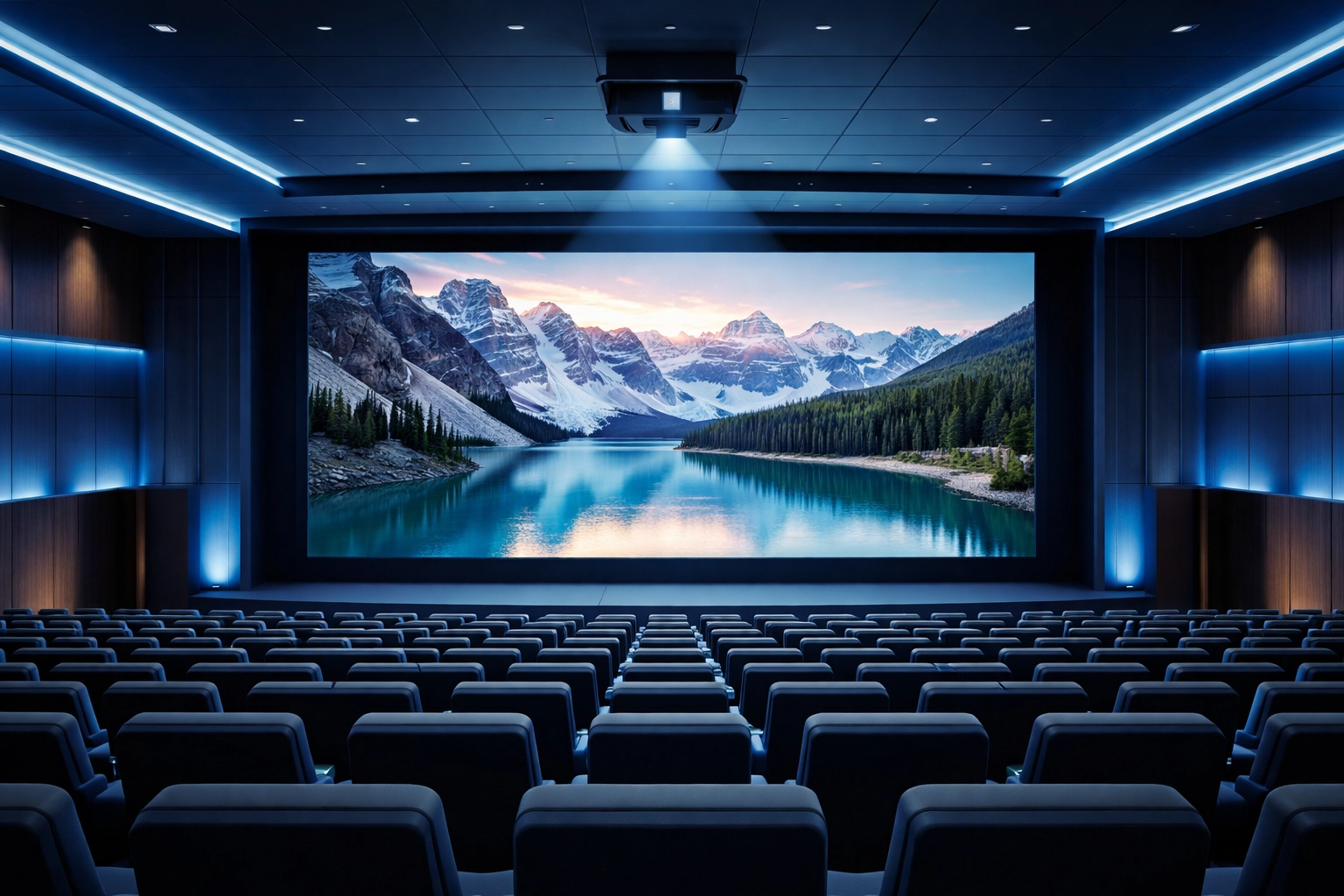
Laser technology dominates large-venue projection in 2026: and for good reason.
Traditional lamp-based projectors require bulb replacements every 2,000–5,000 hours. In a school auditorium running daily assemblies or a corporate training center with back-to-back sessions, that translates to annual maintenance costs and unexpected downtime.
Laser projectors eliminate that problem entirely. Here's the breakdown:
| Factor | Lamp Projectors | Laser Projectors |
|---|---|---|
| Lifespan | 2,000–5,000 hours | 20,000–30,000 hours |
| Maintenance | Frequent bulb swaps | Virtually maintenance-free |
| Brightness Consistency | Degrades over time | Stable throughout lifespan |
| Startup Time | 30–60 seconds warm-up | Instant on/off |
| Total Cost of Ownership | Higher long-term | Lower long-term |
For facilities running projectors 8+ hours per day, laser is the only practical choice. The upfront investment pays for itself within 2–3 years through reduced maintenance and energy savings.
Brightness: How Many Lumens Do You Actually Need?
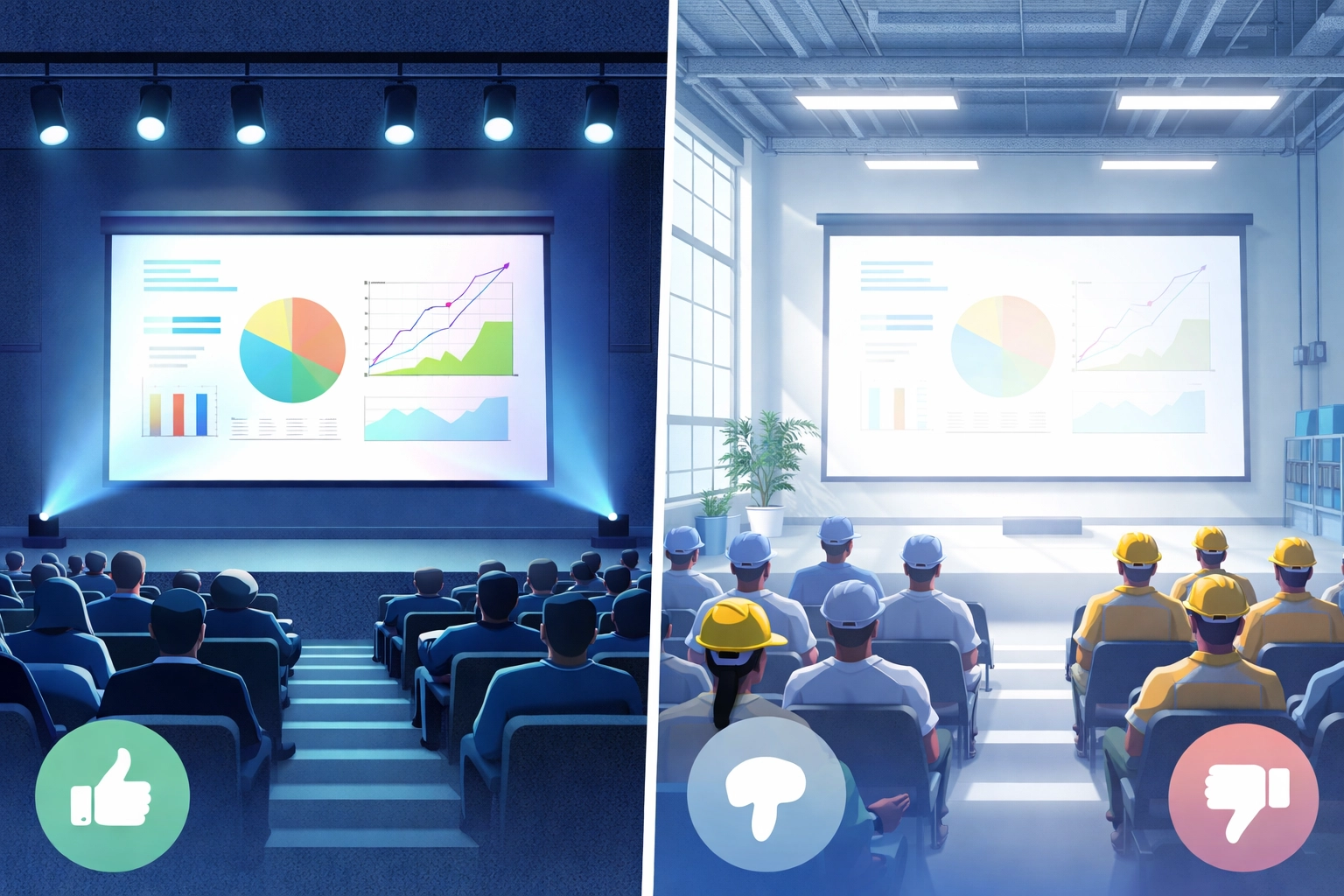
Brightness: measured in lumens: determines whether your image stays visible in real-world conditions. The rule is simple: more ambient light requires more lumens.
Here's a practical guide based on venue type:
- Small lecture halls (controlled lighting): 7,000–10,000 lumens
- Large auditoriums with windows: 10,000–15,000 lumens
- Industrial training centers: 12,000–20,000 lumens
- Outdoor or semi-outdoor events: 20,000–40,000+ lumens
A common mistake? Specifying projectors based on screen size alone. A 200-inch screen in a blacked-out theater needs far fewer lumens than the same screen in a cafeteria with skylights.
Pro tip: Always conduct a site assessment during normal operating hours. The lighting conditions at 2 PM on a Tuesday matter more than spec sheets.
Resolution: Why 4K Is the 2026 Baseline
Full HD (1080p) served large venues well for years. But as screen sizes push past 200 inches and content quality improves, 4K UHD (3840×2160) has become the standard for new installations.
The difference is visible. Text stays sharp at the back of a 500-seat auditorium. Training videos display fine details. Architectural renderings and medical imaging maintain clarity at scale.
For educational institutions showing detailed diagrams or industrial facilities displaying technical schematics, 4K isn't a luxury: it's a requirement.
WUXGA (1920×1200) remains a solid mid-tier option for venues prioritizing widescreen presentations over ultra-high resolution. But if you're investing in a projector expected to last 7–10 years, future-proof with 4K.
Throw Distance and Lens Options
Throw distance defines how far the projector sits from the screen. This matters because:
- Short-throw projectors work in tight spaces: stages with low ceilings or rooms where the projector must mount close to the screen
- Standard-throw projectors suit traditional auditorium configurations with dedicated projection booths or ceiling mounts 30+ feet from the screen
High-end large-venue projectors offer interchangeable lens systems, allowing a single unit to adapt to different throw distances. This flexibility is critical for multi-purpose spaces or organizations managing multiple venues with varied configurations.
Lens shift is another key feature. It allows fine-tuned image positioning without physically moving the projector: essential when perfect center alignment isn't possible.
Schools vs. Industrial Settings: A Side-by-Side Comparison
Different environments demand different priorities. Here's how to match specifications to your venue type:
| Consideration | School Auditoriums | Industrial Training Centers |
|---|---|---|
| Primary Use | Assemblies, performances, lectures | Safety training, technical instruction |
| Typical Screen Size | 150–250 inches | 200–300 inches |
| Recommended Lumens | 10,000–15,000 | 15,000–25,000 |
| Resolution Priority | 4K for detailed content | 4K for schematics and video |
| Environment | Variable lighting, HVAC controlled | High ambient light, dust, temperature variation |
| Runtime | 4–6 hours daily | 8–12 hours daily |
| Key Feature | Quiet operation | Robust cooling, sealed optics |
| Connectivity | HDMI, HDBaseT, wireless | HDBaseT, SDI, network control |
Industrial environments present additional challenges. Dust, temperature fluctuations, and continuous operation demand projectors with sealed optical engines and enhanced cooling systems. Schools prioritize quiet operation and ease of use for non-technical staff.
Installation: Where Most Projects Go Wrong
A $15,000 projector performs like a $5,000 unit when installed incorrectly.
Large-venue projection systems require:
- Proper mounting rated for the projector's weight and heat output
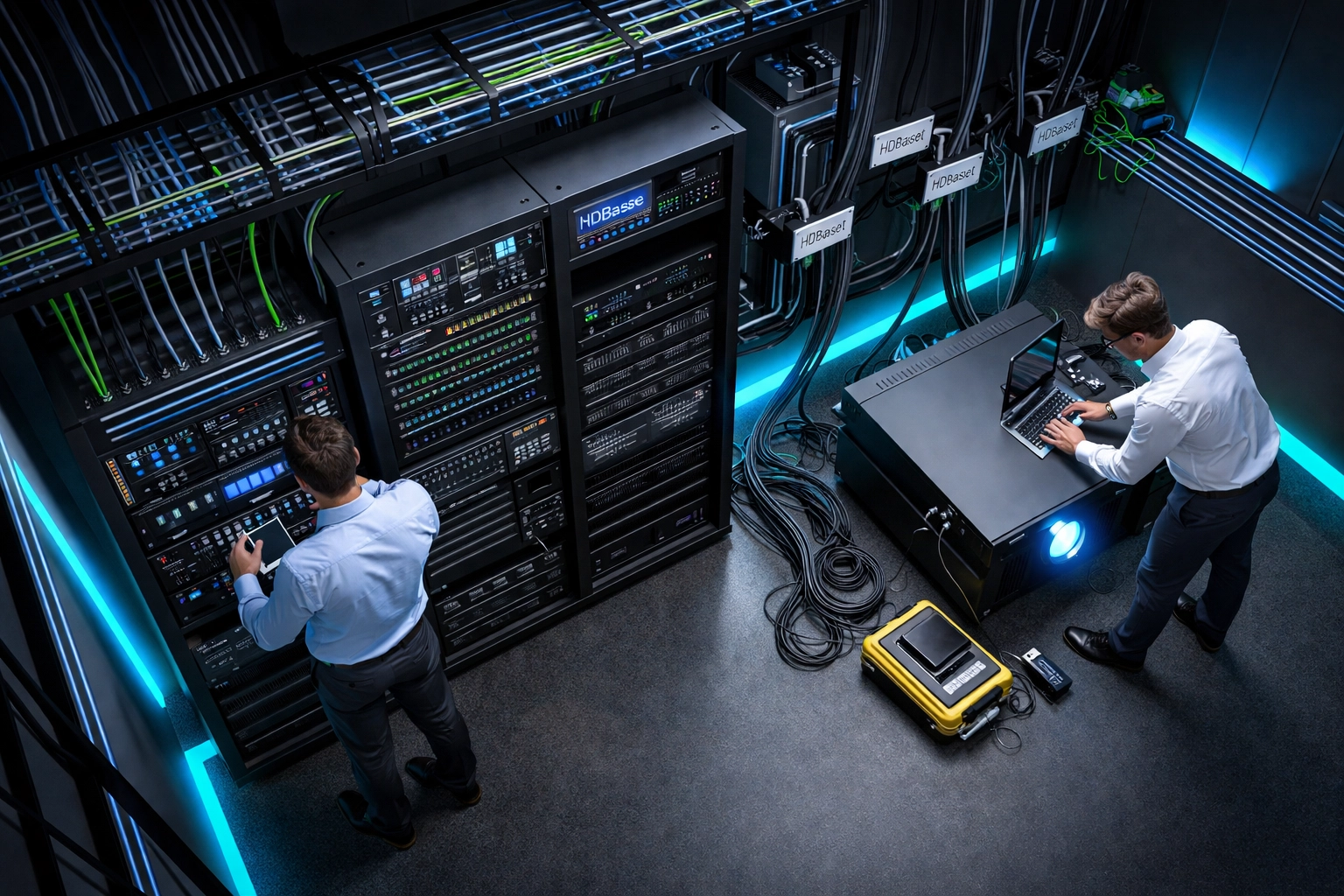
- Structured cabling that supports HDBaseT or fiber runs over 100+ feet without signal degradation
- Electrical infrastructure with dedicated circuits and surge protection
- Network integration for remote monitoring and control
- Calibration specific to your screen material, ambient light, and content type
This is where shortcuts create long-term headaches. Running consumer-grade HDMI cables through drop ceilings. Mounting to drywall without proper backing. Skipping calibration because "it looks fine."
Professional installation ensures your investment performs as specified: and stays that way.
At NJTechland, we've deployed large-venue projection systems across schools, corporate campuses, and industrial facilities nationwide. Our approach includes comprehensive site assessments, structured cabling infrastructure engineered for AV applications, and rigorous testing protocols before handoff.
Connectivity and Control
Modern large-venue projectors integrate into broader AV ecosystems. Essential connectivity features include:
- HDBaseT: Transmits 4K video, audio, and control signals over single Cat6 cables up to 328 feet
- SDI (Serial Digital Interface): Professional video standard for broadcast and industrial applications
- Network control: Enables remote power cycling, input switching, and diagnostics
- Wireless presentation: Supports BYOD environments in educational settings
For multi-site organizations, network-enabled projectors allow centralized monitoring across locations. IT teams can diagnose issues, push firmware updates, and track usage patterns without dispatching technicians.
Our nationwide field services support organizations managing projection systems across multiple campuses: from initial deployment to ongoing maintenance.
The Bottom Line: Invest in the Right System
Choosing a large-venue projector isn't about finding the highest lumen count or the lowest price. It's about matching specifications to your specific environment, usage patterns, and long-term operational requirements.
Key takeaways:
- Go laser. The 20,000+ hour lifespan and maintenance-free operation justify the investment.
- Size brightness to your space. Conduct site assessments during normal operating conditions.
- Standardize on 4K. Future-proof your investment for the next decade.
- Don't underestimate installation. Structured cabling and professional mounting determine real-world performance.
- Plan for integration. Network control and HDBaseT connectivity simplify operations at scale.
Ready to Upgrade Your Venue?
NJTechland delivers end-to-end projection solutions for schools, corporate facilities, and industrial training centers nationwide. From site assessment and equipment specification to structured cabling installation and ongoing support, we handle the complexity so you don't have to.
Contact us today for a professional assessment of your large-venue projection needs. Our team will evaluate your space, recommend the right system, and deliver a turnkey installation backed by 24/7 support.
Get in touch with NJTechland to discuss your project.